Embodied learning in immersive virtual reality: the role of sensory-motor affordances in shaping conceptual and procedural understandings
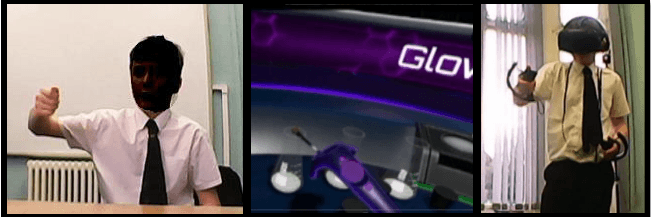
This research looks at secondary school students learning with immersive virtual reality technologies and hypothesises that the sensory-motor affordances of an iVR system can shape the way students make sense of conceptual and procedural knowledge. This work explores notions around movement and embodied interaction between two types of distinct iVR systems and examines the effects of those affordances in relation to: (a) the ways in which enabling locomotion, movement, touch, and gestural interaction can influence students’ sense of presence, body ownership, and agency; and (b) the effect that these sensory-motor affordances can have on students’ measured learning in a science learning context.
A mixed methods design was employed for the empirical work. This involved secondary school interventions in which 27 participants performed chemistry experiments in two virtual laboratories: Labster and HoloLAB Champions. Findings indicate that the sensory-motor affordances of an iVR system play an important role in eliciting perceptual states such as the sense of presence, agency, and hand ownership. Furthermore, the conjunction of these was observed to play at least a partial role in supporting conceptual and procedural understandings, as demonstrated by the way participants used gestures to discuss their experiences. It was found that such gestures instantiated the kinetic, tactile-kinaesthetic properties of interactions with the iVR environments.