Generic Exhibition Platform
The exhibition platform was developed in collaboration with Netzbewegung (software development, Lívia Nolasco-Rózsás (idea, project management & concept), Felix Koberstein (project assistance & concept) and Matthias Heckel (UI/ UX design & motion design).
The generic exhibition platform has been developed within the project Beyond Matter (2019-2023), a collaborative practice-based research project led by the ZKM | Center for Art and Media Karlsruhe. The virtual exhibition architecture essentially consists of exhibition items (digital 3D objects) whose constant rearrangement is orchestrated by a profile-based recommender system in combination with a gravity-based reshuffling system.
This exemplary online environment demonstrates the features of the software and is available on the GitHub account of the ZKM | Karlsruhe. It seeks to encourage art organizations and developers of cultural endeavors to download and use it for their own digital exhibition projects.
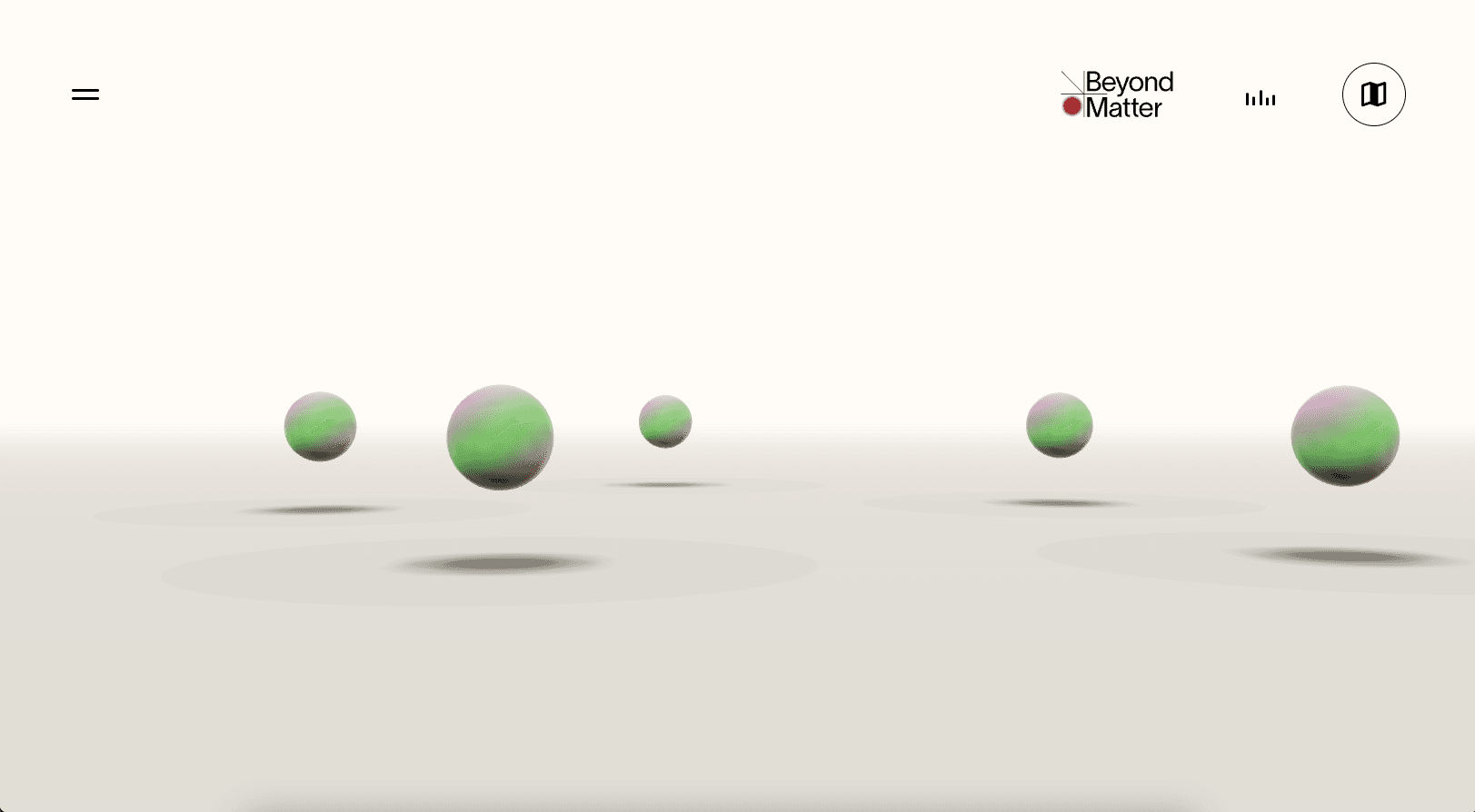
For the creation of a new digital exhibition, digital objects (in form of digital 3D assets), must be uploaded into the respective Content Management System of the generic exhibition platform, alongside information on the assets (author, title, description, etc.), and keywords. Without the digital objects, the exhibition space is an uninterrupted plane. The space is defined by the objects and the user, and the ever-evolving relation between these two agents.
The algorithm developed for the generic exhibition platform determines the position of the digital 3D objects within the digital exhibition space. The profile of an exhibit is described by the values of predefined tags. By observing an exhibit over a certain period of time and spending time in its activity zone, the user profile of the visitor is defined. The similarity between all exhibits and the visitor is calculated continuously. The visitor attracts exhibits that share coinciding levels of similarity as their user profile.
The Generic Exhibition Platform is browser-based and can be visited online: users can navigate through the exhibition space and are able to access information about the exhibits, no matter whether they enter the exhibition model on a smartphone, tablet, or desktop computer.
The user navigates via arrows and by scrolling (mouse or touchpad) while the scenography remains at eye level. By clicking on the map icon, the perspective shifts to an aerial view, which gives the user the possibility to look at the exhibition from above and jump from one exhibit to another. The user does not have an avatar and the presence of other visitors is not indicated, since the exhibition visit is a personalized experience, which doesn't allow interaction between simultaneous users.
The software was developed and first used to emulate and revive Iconoclash. Beyond the Image Wars in Science, Religion and Art, a past landmark exhibition that took place in 2002 at ZKM | Center for Art and Media Karlsruhe and was curated by Bruno Latour and Peter Weibel, together with an interdisciplinary curatorial team.