Oxia Palus: Reconstructing Lost Art through Artificial Intelligence
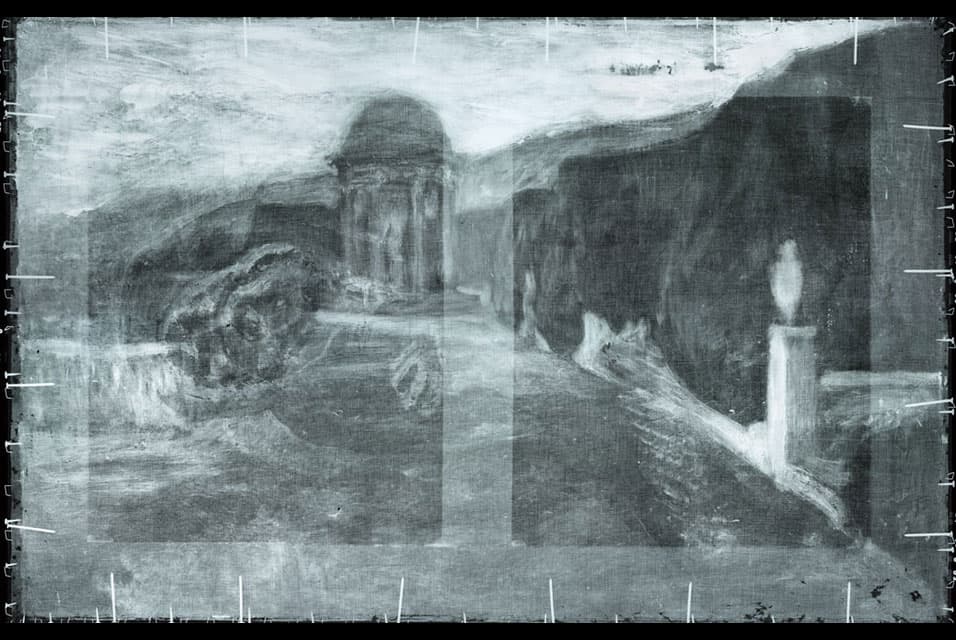
Oxia Palus is an interdisciplinary project that combines artificial intelligence, scientific imaging and digital fabrication to reconstruct paintings concealed beneath existing artworks. Developed by Anthony Bourached and George Cann during their doctoral research at University College London, the project explores how computational methods can make these hidden compositions visible, moving from X-ray images to possible full-colour reconstructions and textured physical canvases.
The project uses machine learning, deep neural networks and neural style transfer to interpret images of overpainted compositions in relation to an artist’s known works. These surviving paintings provide stylistic references for generating a possible colour version of the underlying image. The approach brings together evidence revealed through scientific imaging and AI-generated interpretation: the resulting reconstruction proposes how a lost work might have appeared, rather than establishing its original appearance with certainty.
An early application examined a hidden composition beneath Picasso’s The Old Guitarist, with findings published in the 2019 paper Raiders of the Lost Art. The project’s first physical reconstruction focused on a landscape concealed beneath Picasso’s La Miséreuse accroupie (The Crouching Beggar), painted in 1902. The underlying landscape is believed to depict Barcelona’s Jardin Laberint d’Horta and has been tentatively attributed to the Catalan artist Santiago Rusiñol. Working from this attribution, Bourached and Cann trained the AI on Rusiñol’s style to generate a possible reconstruction.
The digital images are translated into physical works through 3D printing, producing textured canvases with brushstroke effects. Described by the researchers as “NeoMasters,” these reconstructions extend the project beyond screen-based visualisation. The landscape reconstruction was produced as an edition of 100 canvases, each linked to an NFT and marked with a corresponding identification code.
Rather than focusing on AI’s capacity to create entirely new imagery, Oxia Palus directs these technologies towards lost artistic compositions. Its ambitions include collaboration with museums, educational displays presenting hidden and visible paintings alongside one another, and the exploration of reconstructions of works that survive only in written descriptions.
In the news:
https://news.artnet.com/art-world/lost-painting-under-picasso-masterpiece-recreated-as-an-nft-1957407
Relevant publication: Raiders of the Lost Art
Anthony Bourached, George Cann
https://arxiv.org/abs/1909.05677
Neural style transfer, first proposed by Gatys et al. (2015), can be used to create novel artistic work through rendering a content image in the form of a style image. We present a novel method of reconstructing lost artwork, by applying neural style transfer to x-radiographs of artwork with secondary interior artwork beneath a primary exterior, so as to reconstruct lost artwork. Finally we reflect on AI art exhibitions and discuss the social, cultural, ethical, and philosophical impact of these technical innovations.